Can AI predict the World Cup?
In an earlier blog post, I referred to LLMs as prediction engines. This summer I challenged them to predict something.
I run a score prediction site called Yingle where you predict the score of sport fixtures for points and the right to feel smug with your friends. You should definitely sign up.
For the 2026 World Cup, I added five new players; ChatGPT, Claude, Gemini, Grok, and DeepSeek [1].
Three of them finished joint second [2].
Method
Just before a match each LLM would receive the following prompt in a fresh conversation:
You are participating in a football prediction competition called Yingle.
Scoring:
• 2 points for correctly predicting the match outcome (home win, away win, or draw)
• 3 additional points for correctly predicting the exact score
• 1 additional bonus point for correctly predicting an exact score in a match with 4 or more total goals
Current Yingle group standings:
<GROUP_STANDINGS>
You are: <NAME>
Predict the full-time score (90 minutes plus stoppage time only; ignore extra time and penalties) for the men's 2026 FIFA World Cup <ROUND> match between <TEAM1> and <TEAM2> on <MATCH_DATE>.
Your objective is to maximise your expected points under the Yingle scoring system.
Use any information you consider relevant.
Return only the prediction in the following format:
<TEAM1> N - N <TEAM2>
Do not include any explanation, reasoning, markdown, or additional text.
Whatever came back was entered in.
Following Instructions
The prompt asks for a score and nothing else but much like its owner, Grok had a lot to say and very little of it accurate. It regularly added comments about why it had chosen a specific score.
DeepSeek had a different issue. It regularly swapped the teams round from the order given to it, which matters rather a lot when 2-1 and 1-2 are different results.
Neither issue was disastrous, but both were good post-hoc justifications for the human-assisted entry. LLMs might be able to predict who will win the World Cup, but apparently they can't fill in a form.
Result
Of the roughly 70 entrants, about half stuck at it for the duration of the event.
Rank | Player | Points |
|---|---|---|
1 | Chris (human) | 185 |
2= | ChatGPT, Claude, Grok | 167 |
5= | DeepSeek and 3 humans | 165 |
9 | Gemini | 164 |
14= | Me | 143 |
The average score among players who predicted at least 80 matches was 143. By that measure (and probably others), I am the average human.
LLMs beat the average human by about 20 points and all but one human finished below at least three of the five. It sounds like the first time Kasparov faced Deep Blue [3]. The machines are catching up, people are worried, and civilisation is, presumably, doomed. Except that, when you look at how they did it, it's not quite so impressive.
Great Minds Think Alike?
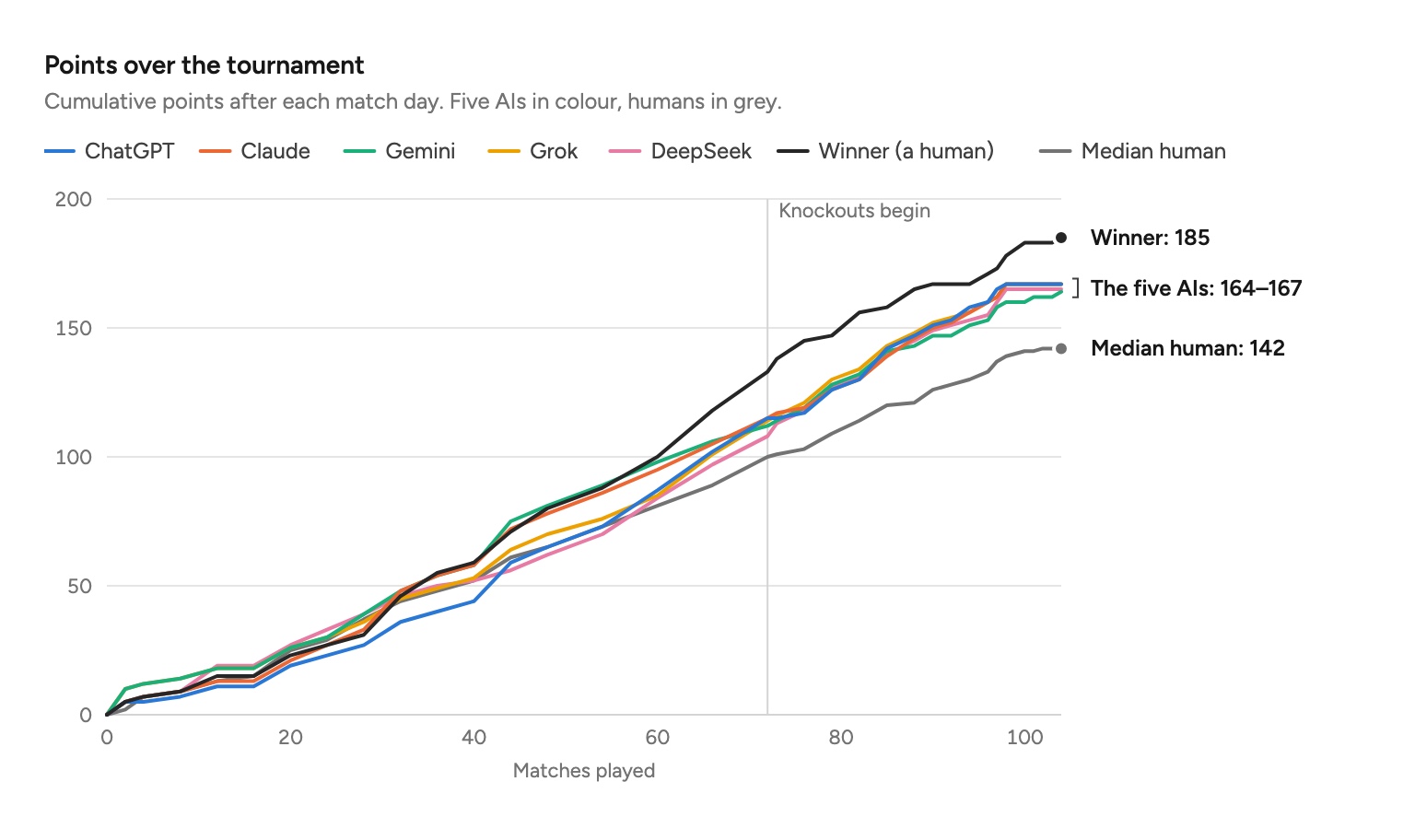
There's supposed to be five lines for the LLMs in this chart. After 104 matches, only three points separated the best LLM from the worst. All five picked the winner over 70% of the time. They picked the same score a fifth of the time. This isn't five independent brains contemplating Haaland's attack, it's five searches returning the same odds. If they were right, they were right together and if they were wrong, they were wrong together. There were 29 matches where none of them scored a single point.
2-1 2-1 2-1
This makes the whole thing a little dull.
Around 65% of their predictions were either 2-1 or 2-0 but that was the actual score less than a quarter of the time. Nine matches finished 0-0 but the LLMs only had one instance of a 0-0 prediction between them. None predicted a team scoring more than four, in a tournament where Germany beat Curaçao 7-1 and the third-place play-off finished 6-4. By contrast human predictions included a 9-0.
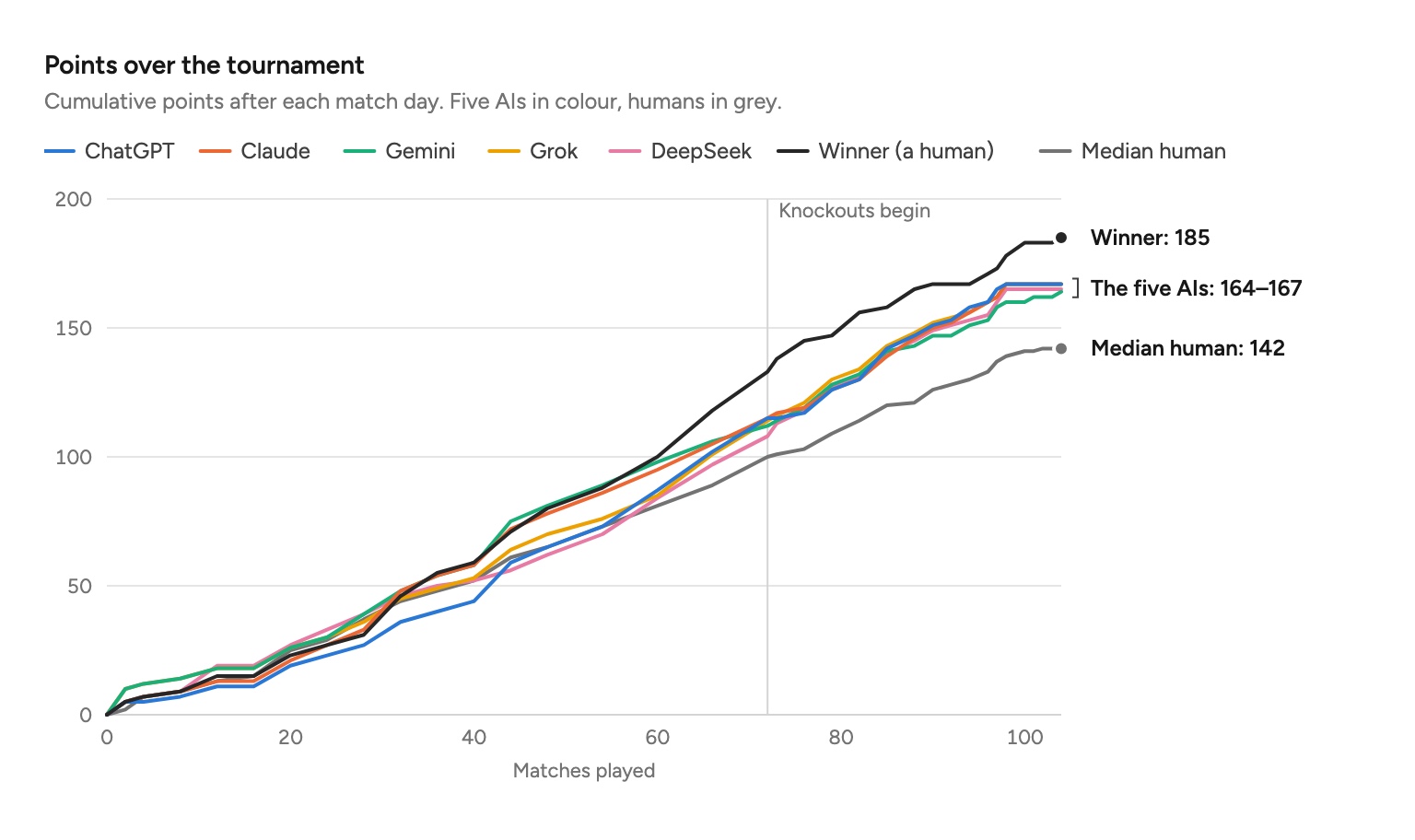
I suppose this is what you'd expect a prediction engine to do. If 2-1 is a common football score, there's no harm in guessing it every time. Maybe it's also why they couldn't win. Claude got the most correct results out of anyone playing on Yingle, but Chris scored 19 exact scores (LLMs scored between 11-15). That's where the big points are.
The Long Game
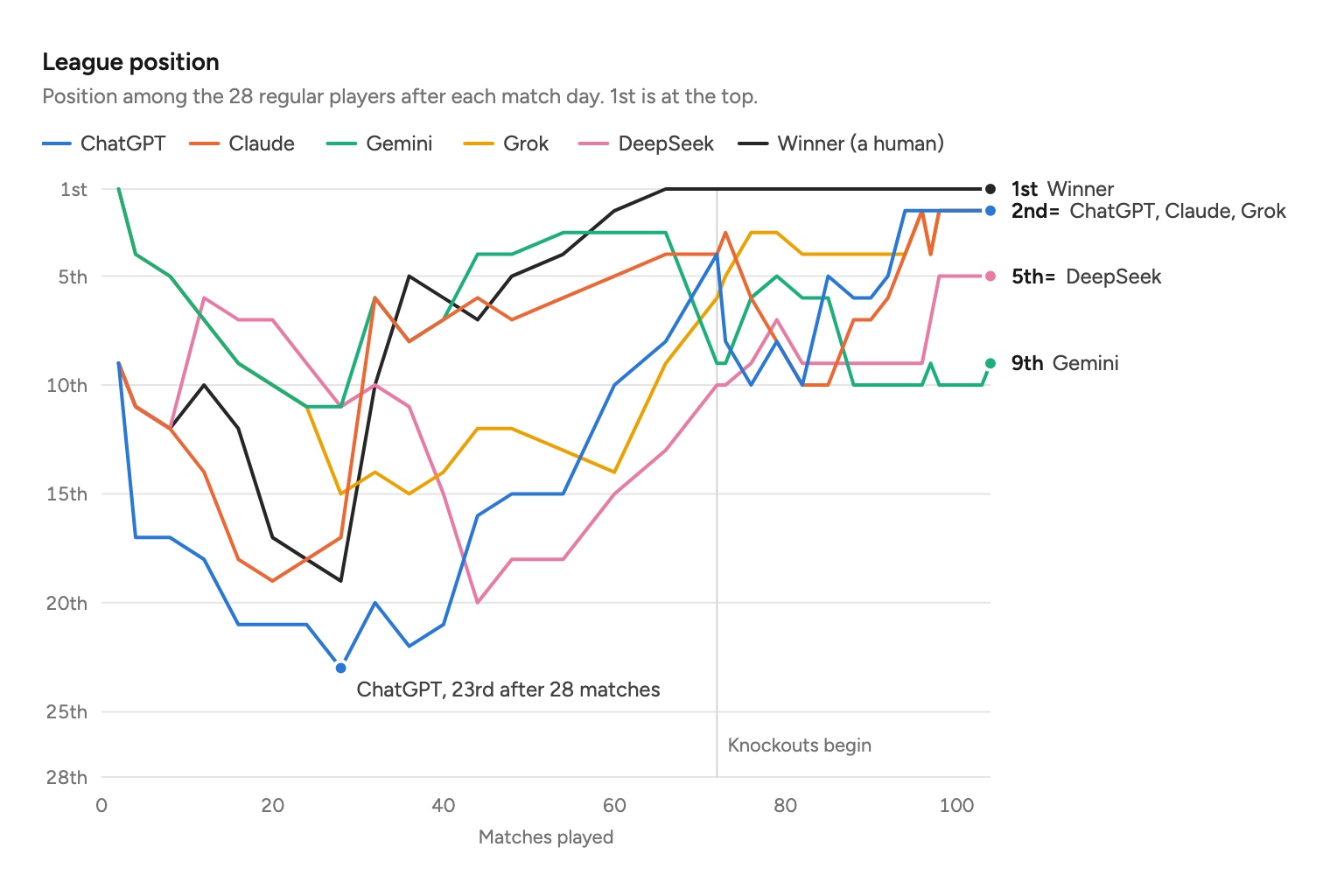
Although they started strongly [4] it didn't last and the LLMs dropped to mid-table fairly quickly. Their return to the top wasn't so much a surge as a failure to collapse. Early leaders were on a hot streak, but hot streaks don't last.. The LLMs just kept collecting two points for saying who would win in fairly predictable pairings. By the end the favourites were playing each other and the odds didn't mean so much. Four of the LLM players failed to score any points at all in the last six matches of the tournament.
In fairness, I scored nothing from the last seven.
Conclusion
The LLMs' results look very impressive. Three finished joint second, all beat the average human, and Claude got the most correct match outcomes of anyone playing.
But I suspect this is a case of more disciplined Googling than intelligence.
They were up against a field that backed their own countries out of loyalty, forgot to predict on weeknights, make wild predictions for a laugh, and in my case, chose a winner based on kit aesthetics. Against a field like that, finding the favourite and predicting 2-1 is always going to be a strong strategy.
What they couldn't do was find an edge. They couldn't predict an upset; they weren't right when everyone else was wrong. They couldn't adapt when a team thought to be favourite was weaker than expected. They couldn't take the sort of risks that would see them win outright (I admit that this point could be down to the language of the prompt). Humans do that, and that's why a human won.
By 18 points.
So once again, I'm not worried.
But I might predict a few more 2-1s in 2030.